Monday, 15 April 2013

DailyBookQuote : 16Apr13 Lewis Caroll's Alice in Wonderland


-          Lewis Carrol (Jan 27, 1832 – Dec 14, 1898)
-          Lewis Caroll’s Alice in Wonderland
An uproarious and unique whimsical children story of Alice's confrontation with the world that is eccentric. The events that take place through Alice's visit in a bizarre "Wonderland" are spontaneous and fantastically unplanned. The characters are remarkably amusing and entertaining. Its language is highly figurative that takes the reader in the realm of true imagination. Enchanting!

Sunday, 14 April 2013

DailyBookQuote : 15Apr13 Margaret Mitchell's Gone with the wind


-          Margaret Mitchell (Nov 8, 1900 – Aug 16, 1949)
-          Margaret Mitchell’s Gone With The Wind
Set against the dramatic backdrop of the American Civil War, Margaret Mitchell's epic love story is an unforgettable tale of love and loss, of a nation mortally divided and its people forever changed. At the heart of all this chaos is the story of beautiful, ruthless Scarlett 'O' Hara and the dashing soldier of fortune, Rhett Butler.

Tuesday, 9 April 2013

DailyBookQuote : 10Apr13 George Bernard Shaw - Man and Superman


-          George Bernard Shaw (July 26, 1856 – Nov 2, 1950)
-          George Bernard Shaw’s Man and Superman
‘A lifetime of happiness! No man alive could bear it: it would be hell on earth’
After the death of her father, Ann Whitefield becomes the joint ward of two men: the respectable Roebuck Ramsden and John Tanner, author of ‘The Revolutionist’s Handbook’. Believing marriage would prevent him from achieving his higher intellectual and political ambitions, Tanner is horrified to discover that Ann intends to marry him, and flees to Spain with the determined young woman in hot pursuit. The chase even leads them to the underworld, where the characters’ alter egos discuss questions of human nature and philosophy in a lively debate in a scene often performed separately as ‘Don Juan in Hell’. In Man and Superman, Shaw combined seriousness with comedy to create a satirical and buoyant exposé of the eternal struggle between the sexes.

George Bernard Shaw was an Irish playwright, socialist, and a co-founder of the London School of Economics. Although his first profitable writing was music and literary criticism, in which capacity he wrote many highly articulate pieces of journalism, his main talent was for drama. Over the course of his life he wrote more than 60 plays. Nearly all his plays address prevailing social problems, but each also includes a vein of comedy that makes their stark themes more palatable. In these works Shaw examined education, marriage, religion, government, health care, and class privilege.

Monday, 8 April 2013

DailyBookQuote : 9Mar13 Gabriel Garcia Marquez's A Hundred Years of Solitude


-          Gabriel Garcia Marquez (March 6, 1927)
-          Gabriel Garcia Marquez’s A Hundred Years of Solitude
One of the 20th century's enduring works, One Hundred Years of Solitude is a widely beloved and acclaimed novel known throughout the world, and the ultimate achievement of a Nobel Prize winning career. The novel tells the story of the rise and fall of the mythical town of Macondo through the history of the family. It is a rich and brilliant chronicle of life and death, and the tragicomedy of humankind. In the noble, ridiculous, beautiful, and tawdry story of the family, one sees all of humanity, just as in the history, myths, growth, and decay of Macondo, one sees all of Latin America.

Love and lust, war and revolution, riches and poverty, youth and senility, the variety of life, the endlessness of death, the search for peace and truth -- these universal themes dominate the novel. Whether he is describing an affair of passion or the voracity of capitalism and the corruption of government, Gabriel Garcia Marquez always writes with the simplicity, ease, and purity that are the mark of a master. Alternately reverential and comical, One Hundred Years of Solitude weaves the political, personal, and spiritual to bring a new consciousness to storytelling. Translated into dozens of languages, this stunning work is no less than an accounting of the history of the human race

Sunday, 7 April 2013

DailyBookQuote : 08Apr13 Rudyard Kipling's Just So Stories


-          Rudyard Kipling (December 30, 1865 – Jan 18, 1836)
-          Rudyard Kipling’s Just So Stories
Rudyard Kipling was born in Bombay and India always remained an integral part of his stories, he was an English short-story writer, poet, and novelist chiefly remembered for his tales and poems of British soldiers in India, and his tales for children. He was awarded the Nobel Prize in Literature in 1907 in consideration of the power of observation, originality of imagination, virility of ideas and remarkable talent for narration which characterize the creations of this world-famous author." Kipling's own drawings, with their long, funny captions, illustrate his hilarious explanations of How the Camel Got His Hump, How the Rhinoceros Got His Skin, How the Armadillo Happened, and other animal How's. He began inventing these stories in his American wife's hometown of Brattleboro, Vermont, to amuse his eldest daughter and they have served ever since as a source of laughter for children everywhere.

Saturday, 6 April 2013

DailyBookQuote : 06Apr13 Paulo Coelho's The Alchemist


 -          Paulo Coelho (Aug 24, 1947)
  • Paulo Coelho's The Alchemist
  •         PAULO COELHO'S enchanting novel has inspired a devoted following around the world. This story, dazzling in its powerful simplicity and inspiring wisdom, is about an Andalusian shepherd boy named Santiago who travels from his homeland in Spain to the Egyptian desert in search of a treasure buried in the Pyramids. Along the way he meets a Gypsy woman, a man who calls himself king, and an alchemist, all of whom points Santiago in the direction of his quest. No one knows what the treasure is, or if Santiago will be able to surmount the obstacles along the way. But what starts out as a journey to find worldly goods turns into a discovery of the treasure found within. Lush, evocative, and deeply humane, the story of Santiago is an eternal testament to the transformation power of our dreams and the importance of listening to our hearts.

Wednesday, 3 April 2013

DailyBookQuote : 04Apr13 Harper Lee's To Kill a Mocking Bird


-          Harper Lee (April 28, 1926)
-          Harper Lee’s To Kill A Mockingbird
The unforgettable novel of a childhood in a sleepy Southern town and the crisis of conscience that rocked it. To Kill A Mockingbird became both an instant bestseller and a critical success when it was first published in 1960. It went on to win the Pulitzer Prize in 1961 and was later made into an Academy Award-winning film, also a classic.

Compassionate, dramatic, and deeply moving, To Kill A Mockingbird takes readers to the roots of human behavior—to innocence and experience, kindness and cruelty, love and hatred, humor and pathos. Now with over 18 million copies in print and translated into forty languages, this regional story, by a young Alabama woman, claims universal appeal. Harper Lee always considered her book to be a simple love story. Today it is regarded as a masterpiece of American literature.

Tuesday, 2 April 2013

DailyBookQuote : 03Apr13 Irvine Welsh's Trainspotting


-          Irvine Welsh (Sep 27, 1958)
-          Irvine Welsh’s Trainspotting
Irvine Welsh's controversial first novel, set on the heroin-addicted fringe of working-class youth in Edinburgh, is yet another exploration of the dark side of Scottishness. The main character, Mark Renton, is at the center of a clique of nihilistic slacker junkies with no hopes and no possibilities, and only "mind-numbing and spirit-crushing" alternatives in the straight world they despise. This particular slice of humanity has nothing left but the blackest of humor and a sharpness of wit. Readers outside Scotland would need to use the glossary in the back to translate the slang and dialect--essential, since the dialogue makes the book. This is a bleak vision sung as musical comedy.

Sunday, 31 March 2013

DailyBookQuote : 01Apr13 Jonathan Swift - Gullivers Travels


-          Jonathan Swift (Nov 30, 1667 – Poct 19, 1745)

-          Jonathan Swift’s Gulliver’s Travels
Considered one of English literature’s first and greatest satirists, Jonathan Swift possessed a timeless genius for pointing out the foibles of human nature that still has the power to provoke, amuse, and, at times, even outrage our modern sensibilities. This representative collection of Swift’s major writings includes the complete Gulliver’s Travels as well as A Tale of a Tub, “The Battle of the Books,” “A Modest Proposal,” “An Argument Against Abolishing Christianity,” “The Bickerstaff Papers,” and many more of his brilliantly satirical works.  Swift’s savage ridicule, corrosive wit, and sparkling humor are fully displayed in this comprehensive collection

Friday, 29 March 2013

DailyBookQuote : 30Mar13 Robert Pirsig's Zen and the Art of Motorcycle Maintenance


 -          Robert M. Pirsig (September 6, 1928)

-          Robert Pirsig’s Zen and the Art of Motorcycle Maintenance
Arguably one of the most profoundly important essays ever written on the nature and significance of "quality" and definitely a necessary anodyne to the consequences of a modern world pathologically obsessed with quantity. Although set as a story of a cross-country trip on a motorcycle by a father and son, it is more nearly a journey through 2,000 years of Western philosophy. For some people, this has been a truly life-changing book.

Thursday, 28 March 2013

DailyBookQuote : 39Mar2013 Lee Iacocca : An Autobiography


-          Lee Iacocca (October 1, 1924)

-          Lee Iacocca : An Autobiography
An American legend, a straight-shooting businessman who brought Chrysler back from the brink and in the process became a media celebrity, newsmaker, and a man many had urged to run for president.

The son of Italian immigrants, Lee Iacocca rose spectacularly through the ranks of Ford Motor Company to become its president, only to be toppled eight years later in a power play that should have shattered him. But Lee Iacocca didn’t get mad, he got even. He led a battle for Chrysler’s survival that made his name a symbol of integrity, know-how, and guts for millions of Americans.

In his classic hard-hitting style, he tells us how he changed the automobile industry in the 1960s by creating the phenomenal Mustang. He goes behind the scenes for a look at Henry Ford’s reign of intimidation and manipulation. He recounts the miraculous rebirth of Chrysler from near bankruptcy to repayment of its $1.2 billion government loan so early that Washington didn’t know how to cash the check.

Wednesday, 27 March 2013

DailyBookQuote: 28Mar2013 Jim Collins 'Good to Great'


-          James Collins (Jan 25, 1958)

-          James Collins’s Good to Great – Why some companies make the leap… and others don’t
  • The Challenge Built to Last, the defining management study of the nineties, showed how great companies triumph over time and how long-term sustained performance can be engineered into the DNA of an enterprise from the verybeginning. 

  • But what about the company that is not born with great DNA? How can good companies, mediocre companies, even bad companies achieve enduring greatness? The Study For years, this question preyed on the mind of Jim Collins. Are there companies that defy gravity and convert long-term mediocrity or worse into long-term superiority? And if so, what are the universal distinguishing characteristics that cause a company to go from good to great? 

  • The Standards Using tough benchmarks, Collins and his research team identified a set of elite companies that made the leap to great results and sustained those results for at least fifteen years. How great? After the leap, the good-to-great companies generated cumulative stock returns that beat the general stock market by an average of seven times in fifteen years, better than twice the results delivered by a composite index of the world's greatest companies, including Coca-Cola, Intel, General Electric, and Merck.

  • The Comparisons The research team contrasted the good-to-great companies with a carefully selected set of comparison companies that failed to make the leap from good to great. What was different? Why did one set of companies become truly great performers while the other set remained only good? Over five years, the team analyzed the histories of all twenty-eight companies in the study. After sifting through mountains of data and thousands of pages of interviews, Collins and his crew discovered the key determinants of greatness - why some companies make the leap and others don't.

  • The findings of the Good to Great study will surprise many readers and shed light on virtually every area of management strategy and practice. The findings include:

  • Level 5 Leaders: The research team was shocked to discover the type of leadership required to achieve greatness.

  • The Hedgehog Concept (Simplicity within the Three Circles): To go from good to great requires transcending the curse of competence.

  • A Culture of Discipline: When you combine a culture of discipline with an ethic of entrepreneurship, you get the magical alchemy of great results.

  • Technology Accelerators: Good-to-great companies think differently about the role of technology.

  • The Flywheel and the Doom Loop: Those who launch radical change programs and wrenching restructurings will almost certainly fail to make the leap. 

  • "Some of the key concepts discerned in the study," comments Jim Collins, "fly in the face of our modern business culture and will, quite frankly, upset some people."


Monday, 25 March 2013

DailyBookQuote 26Mar2013 - JD Salinger's The catcher in the Rye


-          J D Salinger’s The cather in the Rye
The hero-narrator of THE CATCHER IN THE RYE is an ancient child of sixteen, a native New Yorker named Holden Caulfield. Through circumstances that tend to preclude adult, secondhand description, he leaves his prep school in Pennsylvania and goes underground in New York City for three days. The boy himself is at once too simple and too complex for us to make any final comment about him or his story. Perhaps the safest thing we can say about Holden is that he was born in the world not just strongly attracted to beauty but, almost, hopelessly impaled on it. There are many voices in this novel: children's voices, adult voices, underground voices-but Holden's voice is the most eloquent of all. Transcending his own vernacular, yet remaining marvelously faithful to it, he issues a perfectly articulated cry of mixed pain and pleasure. However, like most lovers and clowns and poets of the higher orders, he keeps most of the pain to, and for, himself. The pleasure he gives away, or sets aside, with all his heart. It is there for the reader who can handle it to keep.

Sunday, 24 March 2013

DailyBookQuote : 25Mar2013 Aldous Huxley's Brave New World


-          Aldous Huxley ( Jul 26, 1894 – Nov 22, 1963)

-          Aldous Huxley’s Brave New World
Far in the future, the World Controllers have finally created the ideal society. In laboratories worldwide, genetic science has brought the human race to perfection. From the Alpha-Plus mandarin class to the Epsilon-Minus Semi-Morons, designed to perform menial tasks, man is bred and educated to be blissfully content with his pre-destined role.

But, in the Central London Hatchery and Conditioning Centre, Bernard Marx is unhappy. Harbouring an unnatural desire for solitude, feeling only distaste for the endless pleasures of compulsory promiscuity, Bernard has an ill-defined longing to break free. A visit to one of the few remaining Savage Reservations where the old, imperfect life still continues, may be the cure for his distress. Brave New World is a fantasy of the future that sheds a blazing critical light on the present – It is considered to be Aldous Huxley' s most enduring masterpiece.

Friday, 22 March 2013

DailyBookQuote : 23Mar2013 Salman Rushdie's The Satanic Verses


-          Salman Rushdie (19th June, 1947)

-          Salman Rushdie’s The Satanic Verses
Just before dawn one winter's morning, a hijacked jetliner explodes above the English Channel. Through the falling debris, two figures, Gibreel Farishta, the biggest star in India, and Saladin Chamcha, an expatriate returning from his first visit to Bombay in fifteen years, plummet from the sky, washing up on the snow-covered sands of an English beach, and proceed through a series of metamorphoses, dreams, and revelations.

Thursday, 21 March 2013

DailyBookQuote:22Mar2013 Arthur C Clarke's 2001:A Space Odyssey


 -          Arthur C Clarke (December 16, 1917 – March 18, 2008)

-          2001 A Space Odyssey
2001: A Space Odyssey (1968) is a science fiction novel by Arthur C. Clarke. It was developed concurrently with Stanley Kubrick's film version and published after the release of the film. The story is based in part on various short stories by Clarke, most notably "The Sentinel" (written in 1948 for a BBC competition but first published in 1951 under the title "Sentinel of Eternity"). For an elaboration of Clarke and Kubrick's collaborative work on this project, see The Lost Worlds of 2001, Arthur C. Clarke, Signet, 1972.
The first part of the novel (in which aliens influence the primitive human ancestors) is similar to the plot of an earlier Clarke story, "Encounter in the Dawn".

Tuesday, 19 March 2013

DailyBookQuote : 20Mar2013 The Count of Monte Cristo - Alexandre Dumas


-          Alexandre Dumas (July 24, 1802 - December 05, 1870)


·         The Count of Monte Cristo – Alexandre Dumas

Thrown in prison for a crime he has not committed, Edmond Dantès is confined to the grim fortress of If. There he learns of a great hoard of treasure hidden on the Isle of Monte Cristo and he becomes determined not only to escape, but also to unearth the treasure and use it to plot the destruction of the three men responsible for his incarceration. Dumas' epic tale of suffering and retribution, inspired by a real-life case of wrongful imprisonment, was a huge popular success when it was first serialised in the 1840s.

DailyBookQuote : Mark Twain's The Adventure of Tom Sawyer


-          Mark Twain ‘Samuel Langhorne Clemens’ (Nov 30, 1835 – Apr 21, 1910)

-          Mark Twain’s The Adventure of Tom Sawyer
From the famous episodes of the whitewashed fence and the ordeal in the cave to the trial of Injun Joe, The Adventures of Tom Sawyer is redolent of life in the Mississippi River towns in which Twain spent his own youth. A somber undercurrent flows through the high humor and unabashed nostalgia of the novel, however, for beneath the innocence of childhood lie the inequities of adult reality—base emotions and superstitions, murder and revenge, starvation and slavery.

Sunday, 17 March 2013

DailyBookQuote : 18Mar2013 Leo Tolstoy's War and Peace


-          Leo Tolstoy (September 9, 1828 - November 20, 1910)


  • -          Leo Tolstoy’s War and Peace

-           
'If life could write, it would write like Tolstoy.'

Leo Tolstoy's epic masterpiece ‘War and Peace’ intertwines the lives of private and public individuals during the time of the Napoleonic wars and the French invasion of Russia. The fortunes of the Rostovs and the Bolkonskys, of Pierre, Natasha, and Andrei, are intimately connected with the national history that is played out in parallel with their lives. Balls and soirees alternate with councils of war and the machinations of statesmen and generals, scenes of violent battles with everyday human passions in a work whose extraordinary imaginative power has never been surpassed. The prodigious cast of characters, both great and small, seem to act and move as if connected by threads of destiny as the novel relentlessly questions ideas of free will, fate, and providence. Yet Tolstoy's portrayal of marital relations and scenes of domesticity is as truthful and poignant as the grand themes that underlie them. In this revised and updated version of the definitive and highly acclaimed Maude translation, Tolstoy's genius and the power of his prose are made newly available to the contemporary reader.

Tuesday, 12 March 2013

DailyBookQuote : 13Mar2013 Victor Hugo's The Hunchback of Notre Dame


-          Victor Hugo (February 26, 1802 – May 22, 1885)

-          Victor Hugo’s The Hunchback of Notre Dame
In the vaulted Gothic towers of Notre-Dame lives Quasimodo, the hunchbacked Bell-ringer. Mocked and shunned for his appearance, he is pitied only by Esmerelda, a beautiful gypsy dancer to whom he becomes completely devoted. Esmerelda, however, has also attracted the attention of the sinister archdeacon Claude Frollo, and when she rejects his lecherous approaches, Frollo hatches a plot to destroy her that only Quasimodo can prevent. Victor Hugo's sensational, evocative novel brings life to the medieval Paris he loved, and mourns its passing in one of the greatest historical romances of the nineteenth century.

Monday, 11 March 2013

DailyBookQuote 12Mar13 : Somerset Maugham's Of Human Bondage


“The secret to life is meaningless unless you discover it yourself.”
-          Somerset Maugham, Of Human Bondage
·         
  • Of Human Bondage - Somerset Maugham

Of Human Bondage is considered to be an autobiographical work by Somerset Maugham. Originally published in 1915, Of Human Bondage is a potent expression of the power of sexual obsession and of modern man's yearning for freedom. This classic bildungsroman tells the story of Philip Carey, a sensitive boy born with a clubfoot who is orphaned and raised by a religious aunt and uncle. Philip yearns for adventure, and at eighteen leaves home, eventually pursuing a career as an artist in Paris. When he returns to London to study medicine, he meets the androgynous but alluring Mildred and begins a doomed love affair that will change the course of his life. There is no more powerful story of sexual infatuation, of human longing for connection and freedom. 'Here is a novel of the utmost importance,' wrote Theodore Dreiser on publication. 'It is a beacon of light by which the wanderer may be guided. . . . One feels as though one were sitting before a splendid Shiraz of priceless texture and intricate weave, admiring, feeling, responding sensually to its colors and tones.' With an Introduction by Gore Vidal Commentary by Theodore Dreiser and Graham Greene.

Sunday, 10 March 2013

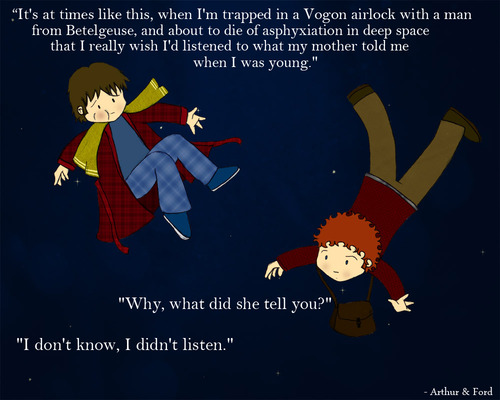
DailyBookQuote : 11th March 2013

Lets join the celebration of Douglas Adams birthday today with quote from another one of his books


 -          Douglas Adams(1952 - 2001) 
  •  The Restaurant at the End of the Universe

Facing annihilation at the hands of the warlike Vogons is a curious time to have a craving for tea. It could only happen to the cosmically displaced Arthur Dent and his curious comrades in arms as they hurtle across space powered by pure improbabilityband desperately in search of a place to eat.

Among Arthur's motley shipmates are Ford Prefect, a longtime friend and expert contributor to the Hitchhiker's Guide to the Galaxy; Zaphod Beeblebrox, the three-armed, two-headed ex-president of the galaxy; Tricia McMillan, a fellow Earth refugee who's gone native (her name is Trillian now); and Marvin, the moody android who suffers nothing and no one very gladly. Their destination? The ultimate hot spot for an evening of apocalyptic entertainment and fine dining, where the food (literally) speaks for itself.

Will they make it? The answer: hard to say. But bear in mind that the Hitchhiker's Guide deleted the term "Future Perfect" from its pages, since it was discovered not to be!

"What's such fun is how amusing the galaxy looks through Adams' sardonically silly eyes."

Thursday, 7 March 2013

DailyBookQuote : Jane Austin's Pride and Prejudice


-          Jane Austin (16 December 1775 – 18 July 1817)
-          Pride and Prejudice

"It is a truth universally acknowledged, that a single man in possession of a good fortune must be in want of a wife."

So begins Pride and Prejudice, Jane Austen's witty comedy of manners.

One of the most popular novels of all time, that features splendidly civilized sparring between the proud Mr. Darcy and the prejudiced Elizabeth Bennet as they play out their spirited courtship in a series of eighteenth-century drawing-room intrigues. Renowned literary critic and historian George Saintsbury in 1894 declared it the "most perfect, the most characteristic, the most eminently quintessential of its author's works," and Eudora Welty in the twntieth century described it as "irresistible and as nearly flawless as any fiction could be."

Austen's works critique the novels of sensibility of the second half of the 18th century and are part of the transition to 19th-century realism. Her plots, though fundamentally comic, highlight the dependence of women on marriage to secure social standing and economic security. Her work brought her little personal fame and only a few positive reviews during her lifetime, but the publication in 1869 of her nephew's A Memoir of Jane Austen introduced her to a wider public, and by the 1940s she had become widely accepted in academia as a great English writer. The second half of the 20th century saw a proliferation of Austen scholarship and the emergence of a Janeite fan culture.

Wednesday, 6 March 2013

Daily #BookQuote : 7th Mar 2013


― Fyodor Dostoyevsky (1821 – 1881)


  • The Idiot by Fyodor Dostoyevsky

Returning to Russia from a sanitarium in Switzerland, the Christ-like epileptic Prince Myshkin (The Idiot) finds himself enmeshed in a tangle of love, torn between two women—the notorious kept woman Nastasya and the pure Aglaia—both involved, in turn, with the corrupt, money-hungry Ganya. The 26 year old Prince is considered a misfit, an Idiot and scorned by the society of St. Petersburg for his trusting nature and naivety, he finds himself at the center of struggles for materialist pleasures by the people all around him. Unfortunately, Myshkin's very goodness precipitates disaster, leaving the impression that, in a world obsessed with money, power, and sexual conquest, a sanatorium may be the only place for a saint  

In the end, Myshkin’s honesty, goodness, and integrity are shown to be unequal to the moral emptiness of those around him.

Tuesday, 5 March 2013

Daily #BookQuote : 6th Mar 2013


Daily #BookQuote : 6th March 2013

One of the personal target I have planned for this year 2013 is that I will try and read at least one book every month. To keep myself steadily on that path, I will share a quote from one of my favorite book every day, from today. 

Hope to maintain it in a disciplined manner for the next 365 days...

The Hitchhiker's Guide to the Galaxy by Douglas Adams
The Hitchhiker's Guide to the Galaxy by Douglas Adams
  • The Hitchhiker's Guide to the Galaxy by Douglas Adams
Seconds before the Earth is demolished to make way for a galactic freeway, Arthur Dent is plucked off the planet by his friend Ford Prefect, a researcher for the revised edition of The Hitchhiker's Guide to the Galaxy who, for the last fifteen years, has been posing as an out-of-work actor. Together this dynamic pair begin a journey through space aided by quotes from The Hitchhiker's Guide ("A towel is about the most massively useful thing an interstellar hitchhiker can have") and a galaxy-full of fellow travelers: Zaphod Beeblebrox--the two-headed, three-armed ex-hippie and totally out-to-lunch president of the galaxy; Trillian, Zaphod's girlfriend (formally Tricia McMillan), whom Arthur tried to pick up at a cocktail party once upon a time zone; Marvin, a paranoid, brilliant, and chronically depressed robot; Veet Voojagig, a former graduate student who is obsessed with the disappearance of all the ballpoint pens he bought over the years.